Thursday, April 7, 2011

Elfin Lakes tour

Elfin Lakes ski tour
Eric Meier and Jeff Schomaker
Friday-Saturday April 1-2, 2011

You're a grad student being hammered by research work.. sitting around day after day running simulations and writing papers. You're in Seattle near the end of the winter.. it's been raining something fierce and moss is growing between your toes. What do you do? You get your ass out into the mountains for a ski tour! I tell you, it's like a religious experience for me to get way up in the mountains, preferably in the sun with an expansive view of wild and ragged mountain peaks. This trip was no exception. Awesome. Everything comes into focus out there.

Some noteworthy things have happened since I last blogged (like getting engaged!), but I haven't gotten out on many good adventures this winter. In November, just before they shut down Hwy 20 over the Cascades, Reid, Jeff, and I did a nice skiing day trip up by Blue Lake. Also, the three of us did a day trip at Baker in January. Finally, I got out again! Jeff and I headed up to Canada. Jeff was none too optimistic that the weather or skiing would be any good. But it all turned out pretty well.

All pics (and a video somewhere near the end of the picture set) can be found at
https://picasaweb.google.com/remierice/20110401ElfinLakesWJeff#

We headed up across the Canadian border to Garibaldi Provincial Park on Friday. As usual when one of the infamous Meier brothers crosses into Canada, they want to do a full cavity search. Well, it's not that bad, but they always stop me going in for a few minutes. It's kinda hilarious how the Canadians have a need to waste their own time and mine. I joked with Jeff, who was driving, that they always stop me on the way into the US too.. but they give the driver the cavity search. (Actually, we did get stopped coming back into the US! They harassed us for 1/2 hr or so. Jeff was sweating bullets because he had some prescription pain killers for emergencies. They let him off the hook, telling him he should not cross with painkillers.. but if he was going to, he should crank up his operation some.)

We stayed in an awesome shelter in Garibaldi Park near Elfin Lakes. The shelter comes equipped with a heavy duty propane heater, a kitchen with four propane stoves and lots of pots. It's user maintained and is in good shape. Lots of propane.

Elfin Lakes Shelter upon arrival Friday eve.


On Friday night, the shelter was pretty quiet. Only three chicks from Vancouver were there. They were pretty cool and didn't smell too bad, which was good. One of them was a nerd like me and wanted to play some chess. I took her up and we had a good game. Two of them spoke French (one was a teacher of French), so I spoke some with them. She said she thought Americans like the French (so maybe that's why I would pick up the language). Au contraire, I told her. Most Americans are French-hating rednecks.

We slept like lazy bums until 7:00. When we woke up, things looked marginal. But after about 1/2 hour, it looked absolutely gorgeous and we seized the day. Good visibility was needed to navigate the terrain around there without being in danger of avalanche, cornice failure, etc.


Elfin Lakes shelter with Garibaldi in background


Elfin Lakes area panorama

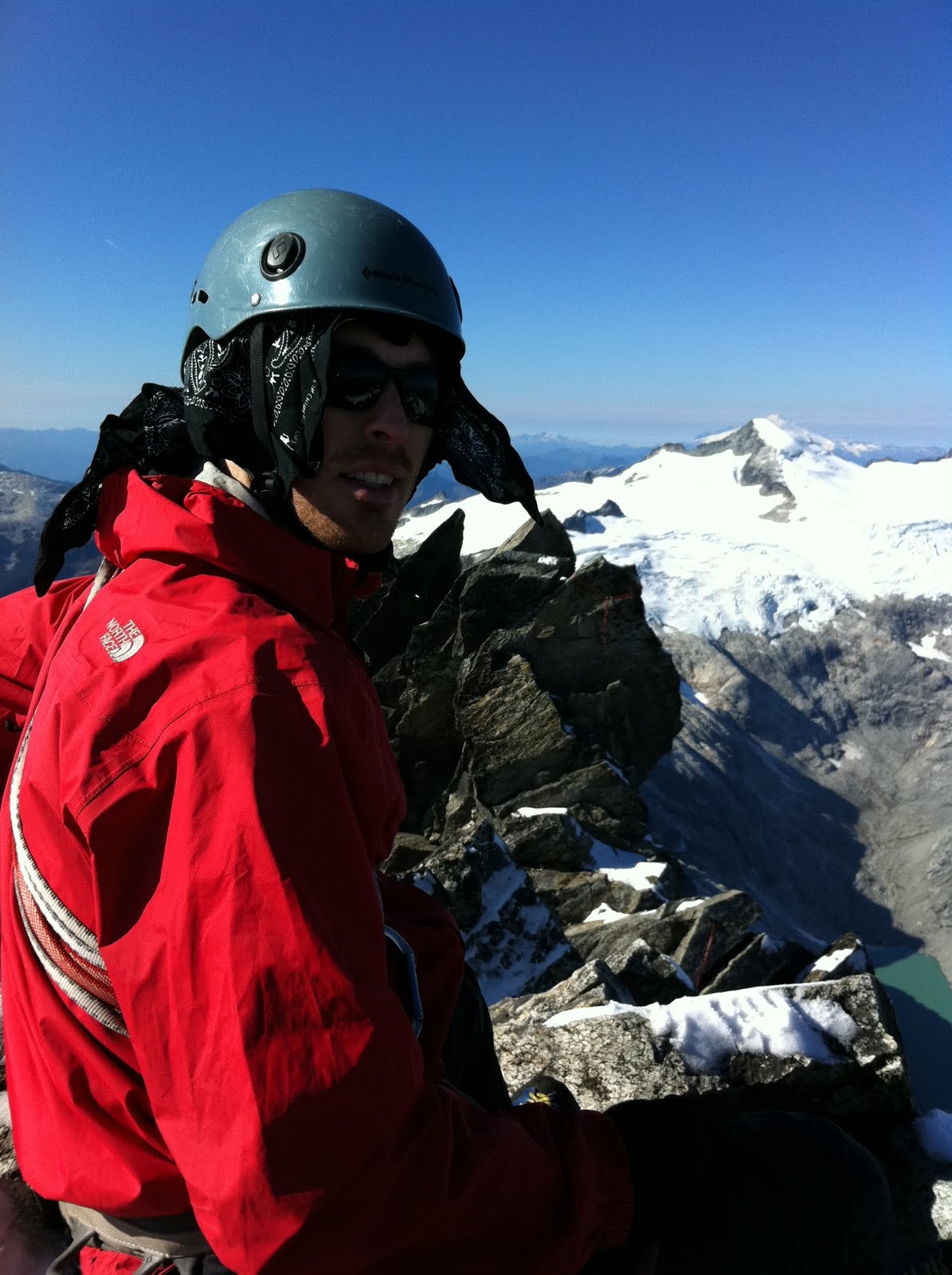
After some vigorous exercise, we made it to the top of Diamond Head which is about 7,000 ft high at the shoulder of the larger Garibaldi. Looking around at the top was quite a treat.

Panorama from the top of Diamond Head. Garibaldi at right. Coast Range in distance.

Had some great turns on the way down... until I sprained my ankle during the last downhill run. It was a pretty bad sprain and made it quite painful to struggle down seven miles to the car. It's five days after the injury, and the swelling is basically gone, but it's still tough to go down stairs or to move aggressively at all. Anyway, it's a small price to pay for the pleasure of the trip.

On the way down (limping along), we ran into a weird dude from Vancouver who wasn't using his skis. They had good skins on them and he had good boots, but he was carrying them. He asked us, "why does anybody use these things on the way up.. I do better walking." We said "Uhhh. You new to this? You might want to try skinning again." Skinning is a great way to get around in the mountains.

Wednesday, October 20, 2010

Forbidden Peak

Forbidden Peak West Ridge
Reid McCaul and Eric Meier
Oct. 16-17, 2010

Reid and I thought about doing something a little more aggressive than this. I’m glad we didn’t. This was quite sufficient. I didn’t know it until Reid pointed it out, but this route, (Forbidden Peak, West Ridge), is one of the fifty climbs made famous in the popular book, Fifty Classic Climbs in North America (http://en.wikipedia.org/wiki/Fifty_Classic_Climbs_of_North_America), by Roper and Steck. I’ve climbed one other route on their list – Mount Rainer's Liberty Ridge.

Mt Forbidden photo by John Roper, July 27, 1968. The west ridge is the one pointing toward the upper left. The glacier extends at least 1000 feet into Boston Basin (to the left of the peak in this photo). Now, it spans just a couple hundred feet of altitude.

We got on the road from Seattle Saturday morning at about 7:30. Made a grocery stop and picked up some food including a bag of fabulous trail mix which was soon to be eaten by mice. Checked in at the ranger station in Marblemount at 9:30 and got to the TH (about 3,500 feet elevation) at around 10:30. Route from the road up past the old diamond mine and to the Boston Basin high camp was fairly straightforward except where the trail was washed out in a few places near the low camp. Temperatures in the shade were near freezing, and ice presented a challenge at some stream crossings. Snow was sticking in spots as we reached 5,000 ft. Got to high camp at 6,400 feet at about 3:30. Had some time to kill and did a 2-hour side trip over to a saddle just below Mount Torment (all the peaks around here seemed to have great names). From the saddle, had a great view of Eldorado Peak. From anywhere in Boston Basin, the view of Johannesburg Mountain is striking. I got some great pics of all this scenery including sunset. Unfortunately, my camera did not finish the trip with me. After some discussion of the sub-relativistic Doppler shifting of light, we were tuckered out and hit the rack.

We woke at 5:30 and got going by 7 Sunday morning. We had noticed a few mice the previous night, and I put my trail mix into my drawstring canvas bag and into my pack. This was not adequate protection from these driven little bastards. They had eaten almost all of it by morning. They brazenly snuck in to grab the last morsels even as I was chasing them around camp with intent to kill.

Beckey’s guidebook description said it would take 6 hrs to the summit, then 4 hrs back down to high camp. That would make it 5 pm. Barely enough time to make it out before darkness which fell at 7 to 7:30 pm. Beckey is not known for the high accuracy of his time estimates (or for his exact route descriptions), so we expected our headlights might come in handy. On the approach hike, we quickly warmed up and took off our down jackets. I took my camera off and set it down. I never picked it up again. I realized 15 minutes later that I’d left it. I figured I could probably find it on the way down. No such luck. The terrain around there is too monotonous, not to mention that it was getting dark and we were in a hurry. The marmots are having a good time with it, I’m sure. The final approach to the technical section involves crossing tiny little glacier that has almost melted away (thanks global warming!). We decided it was beneath us to put our crampons on. This proved to be a minor mistake. Reid got off the glacier and onto a nearby rock outcrop sooner than I did. I went a little higher where it’s a little steeper and a little icier… where my mountaineering boots could barely penetrate the ice to give me any grip. This made for some fun ice climbing on a 45 degree slope with only my mountaineering axe. But I made it after five or ten minutes of quad burning workout. I think this part of the approach was the beginning of the end for my quads which are still sore now, 3 days post climb. After getting onto the rock, things scarcely improved during the mixed rock and ice, tooth and nail up to a safe spot. Greater respect for this tricky approach would be appropriate.

It was a great relief to put on climbing shoes and rope up. The usual couloir was out of shape, so we took the alternate route recommended by Beckey. Ascent is straightforward to the notch in the west ridge. We simulclimbed a good chunk before reaching some difficult sections. One of the first moves is a long step over a spectacular abyss. My oh my, it is exciting. The route favors the north side of the ridge. Unfortunately, that’s where the snow collects first. But there was never more than a couple of inches on the important holds, so it only added a point or two to the climb’s class 5.4(ish) rating. Mostly, it was easy class 4 scrambling albeit with dizzying drops on either side. After getting off to a rocky (icy?) start on the glacier, I was happy to have Reid (a far more experienced climber than me anyway) in the lead.

Near the summit, Mount Baker peeked out from behind Eldorado which had been neatly hiding it. On top at 1 pm, exactly 6 hours after departing camp, the summit views were magnificent. Reid took a few photos with his iPhone.

Me on top of Forbidden. Eldorado is seen with Baker peeking from behind it.


Here’s the view of Johannesburg from the top.


Reid with Mt Logan in background. Heavily crevassed Fremont Glacier is below Logan.

Our downclimb took us 5.5 hours. Maybe we can blame the snow for the slow pace. Spent half an hour looking for my poor camera to no avail. Raced down the mountain in the near dark. Managed to stay on the trail almost exclusively which was no mean feat. This rapid descent took a toll on the quads, knees and feet. As Reid says, “the dogs were barking”, meaning our feet were hammered. We had quite a philosophical discussion about how some people can manage to enjoy climbing despite the significant pain that must be endured.

Reached the car just before 9 pm. I knew Anita would be getting concerned, so I was anxious to get down into cell phone range. (Reid had told his gf that she should not worry until midday Monday unless the area is hit by a nuke.) On the way down the dirt road, we were hailed by a woman in an SUV. She was distressed and asked us if we knew much about the route up Eldorado. Why? Her husband was due to be down that evening and he hadn’t called yet. Reid (who has done Eldorado) tried to explain that the routefinding is tough and they may be spending the night up there. Impressive that she drove two hours from Bellingham. Clearly her hubby is a fairly new climber or she would be used to this shit by now. Hopefully he made it down safely.

All in all, a fabulous climb. Great to be up there on this classic route without seeing any another climbers. Great weather. Snow will probably make the route impossible later this week.

Tuesday, August 31, 2010

Dark Side of the Moon

That title sounds cool, but should be amended to read "Far Side of the Moon". The moon rotates around the earth and is "locked" so that we only see one face of it. My sister and bro-in-law were wondering what the explanation was for this. I took a crack at it, and had a tough time convincing them. So, I've studied up and am writing it here for them.

Why is the moon locked facing the earth? I looked this up years ago and learned that it is basically due to what's called "tidal locking". From the wikipedia article on tidal locking, "A tidally locked body takes just as long to rotate around its own axis as it does to revolve around its partner." Tides basically cause an spherical body (like the moon and earth) to be stretched in the direction of it's orbital partner.

How is it that something related to tides could cause a celestial dance between giant objects like the earth and moon? Don't tides just make the oceans go up and down? The image below gives some idea of what's happening on earth.


Tidal bulges. Earth's oceans are stretched toward the moon on the side facing the moon and away from the moon on the opposite side. The diagram above also shows earth's rotation dragging the stretched shape slightly counterclockwise such that the bulge "leads" the moon.

The moon is also stretched like the earth, and the stretched direction always points to the earth. This is because when the stretched direction is not pointed at the earth, there is a correcting force that rotates the stretched direction to point at earth.

When the moon was liquid, it was bulged, and rotated "under the bulge" just like the earth does. As it cooled and froze, it's rotational energy must've tried to move the bulge from its orientation toward earth, but the corrective force mentioned won and we have our tidally locked moon.

Cool, huh? My dad asked the tough question of why the stretched shape is formed. For example, why doesn't earth just have a single bulge on the side facing the moon? Why another bulge on the opposite side? How the devil does this really work? Ike Newton was one of the first (if not the first) to understand this scientifically. The wikipedia page on tidal force is excellent. A summary follows.

Tidal forces diagram. Moon's gravitational forces (red arrows) are acting on the earth (the black sphere).

The red arrows in the top pane shows the moon's gravity which is weaker farther from the moon. The earth (the black sphere) is in free fall. Thus, it makes sense to subtract off the average gravitational force acting on the earth. This is done in the lower pane. Now you can see the forces that cause the tidal stretching.

Keep in mind that the tides are only ~10 feet. This is a tiny bulge for an object with a radius of 20 million feet.

Another cool thing I learned in the article is that the debris that makes up Saturn's rings would have condensed into moons if not for tidal forces exerted by Saturn.


Cassini image of Saturn.

Tidal forces are stronger closer to the source of gravity. Moons formed around Saturn when the debris was far enough away that tidal forces didn't disturb the formation.

Monday, August 30, 2010

windward side rain / orographic lifting

The issue of rain on the windward side of mountains arose in my trip last week. My dad attributed the phenomenon to cooling of the rising air mass. The reasoning is that air is cold at high elevation, so as the air gets higher, it cools, reaches dewpoint, and starts releasing water. After further study, fundamentally, it is correct that the air cools and reaches dewpoint. However, the cause for the cooling is kinda ... cool. It's called orographic lifting. Basically, the air expands as it goes to high altitude. As it expands, the air does work on the air that it displaces. The work energy had to come from somewhere. It came from the energy of the air molecules. Temperature is, basically, a measure of the average speed of the air molecules.

For further reference, see
http://en.wikipedia.org/wiki/Orographic_lift

On that page, there is a beautiful picture of clouds being formed at the crests of waves, called gravity waves. Orographic lifting can cause air at the crests of the waves to reach dewpoint and form clouds.


Clouds are created at the crests of gravity waves due to orographic lifting. These waves are created as air flows over an island in the southern Indian Ocean.

For more on gravity waves, see
http://en.wikipedia.org/wiki/Gravity_wave

Sunday, August 29, 2010

horseback trip into Gilbert Basin

I just spent a week in Utah, visiting Tess, Tim, and Zoey in SLC on either side of a 3 day horsepacking trip into the innermost valleys of the Uinta mountains.

Visiting Tess, Tim, and Zoey in SLC was nice. Zoey is 8 months old now, and is getting quite animated in her interaction with people.


Isn't she cute?! We went for a hike up Big Cottonwood Canyon. Tim and I played some golf in a serious windstorm. We also got in a few hands of bridge. Their pups, Howie and Sadie, are doing very well too and are as sweet as ever. We had a lot of fun one night doing accents. Tim has me beat on his Snoop Dog accent, but I think I've got him in the Aussie category.

Next stop was Roosevelt to get ready for our 3 day ride. The hosses were in good shape. My parents just got a new horse named Coco in addition to their old hands, Boss and Mischief. I was to ride Boss, who, true to his name, is the head horse, nipping the others as required to exert his authority. Steve had drawn up a route for us -- head up and over Fox Queant Pass and down in to the Uinta River drainage. Then up to Gilbert Basin. I've ridden my parents' horses on and off over the past several years, but never for more than an hour at a time. This time, I was gonna ride 8 hours a day for three days! I hoped my bike seat had me saddle ready.

Getting the horses loaded up is no mean feat. Saddle blanket, saddle, front and back girth hitches. Front saddle bags. Back saddle bags. Bridle. Breast strap. Boots. Yes, rather than regular metal horseshoes, nailed into hooves, my parents prefer rubber boots which snugly fit around the hoof and are strapped around the ankles. Of course, the usual camping gear has to be organized too.

The horses were cruising slowly on the first day, not in any rush to get far away from their trailer which they knew would bring them back to their comfortable pasture, and a steady supply of hay and water. We were a little off the pace, but made it to Fox Queant Pass some time around 2 pm. The trail is rocky and the horses had to take it slow. Most horseback riders probably wouldn't even consider taking their horses on a trail like this. It's a touch hiking trail! But Mischief and Boss are expert trail horses and Coco is well on his way.


Looking NW from Fox Queant Pass

From the Pass, we cruised to our campsite past some pretty lakes and gorgeous meadows formed by beaver dams.

I'm reclining on the saddle trying to rest my back which got rather sore. Beaver-created meadow to the right of my head.


The campsite location (near the trees above Steve's hat) was gorgeous. Gunsight pass is just below the sunlit clouds. See the low, sharp peak? Maybe the pass got its name because this sharp peak is like the front post in a common gunsight.


On our first night, we watched the full moon rising.

The spot I slept is behind me in the photo. I was rather chilly that night. Daisy hung with me a while, then retreated to the tent with my parents. Frost covered my bag. Really, I wasn't too cold except for my toes. But I did squeeze into the tent the next night.


Horses grazing in the morning. This pretty stream ran right past our campsite.

The next day, I was up at the crack (partly to try to warm up). Looked out in the meadows, but didn't see any game. Of course, the horses had cow bells around their necks and game probably could hear us miles away... The good thing is that bears could too and probably stayed far away. We got going pretty early. Terrain was again quite rocky. We reached our destination, though: Gilbert Basin. The basin sits just below Gilbert Peak (13,442 ft). My dad and I had been to this basin back in 2003. On that trip, we saw lots of elk. This time, it was still glorious, but no elk that we could see. They must've been laying low.

Gilbert Basin panorama in 2003.


Mom and Dad at our high point in the middle of Gilbert Basin.

The ride back down that day got pretty scary when Coco blew out a rear horse shoe. The arabs (Coco and Mischief are partly Arabian) tend to freak out when a rear horse shoe comes off their foot and hangs by the ankle strap. They start kicking wildly trying to get the thing off. Steve dismounted, asked me to stop Boss, and started working on the rear boot. I tried, but Boss.. well, he's the Boss, not me. Maybe if I was a more experienced rider, I could've halted him. But he walked, encouraging Coco to walk instead of stay still. Steve got knocked under Coco and the horse spooked and ran. Fortunately, Coco didn't step on him. Stopping is tough for these horses. Maybe it has to do with their insatiable appetites. They want to go, go, go until they get to some grass. Then, maybe they're willing to stop and munch. Any chance they get, really, they try to stop and eat. They are eating machines which makes sense for 1100-pound animals.

Sleeping in the tent was nice and warm. The next morning, we started back. After straightening out my stirrups, it seemed we were ready to make some good time. A few minutes down the trail, though, my saddle started sagging sideways. I knew this was bad news -- when the saddle slides sideways, the horse flips out. Boss started trotting, cantering... my mom yelled for me to bail. I did. That's where the crash skills from the snow sport (skiing / snowboarding) days come in handy. No problemo. We realized we hadn't tightened the saddle cinch!! Doh! Another lesson learned.

Navigating the rocky trail back on the 3rd day of riding was pretty tiring. We managed though. And the scenery was amazing.


My favorite from the trip: the hairbell.

Another nice flower: Daisy. :)

Looking back SW from near Fox Queant. The animals are all lined up behind Steve .. well, he's an animal too, really :)


Cowboy Eric. Anita thinks I look a little like the Marlboro man in this photo.

This trip was tres enjoyable overall. In general, I think Boss was a great trail horse for a beginner like me. Quite an experience to get out on a 40 mile horseback ride. Always fun to spend time with my family.

We had a few science/physics-related discussions that I plan to blog about soon. Teasers: Why does the moon always face the earth? Why does rain tend to fall on the windward side of mountains.

Tuesday, May 25, 2010

Madrid

I'm getting kinda burned out on blogging about this trip. So, first, I'll give you some thoughts on totally random things. Then I'll short change you on the Madrid stories because I'm lazy.

First random thing: Anita and I made mayonnaise this weekend! Turns out it's a little tricky, but totally doable. It's basically made from two egg yolks and 1.5 cups of oil. You beat the oil into the egg yolks a tiny bit at a time... Go too fast and you have an puddle of oil with some funk in it, which is what happened to our first batch. But the second batch was awesome.

Next random thing: I took a tour of the Boeing manufacturing plant in Everett as part of a VIP group from our UW Aeronautics and Astronautics Department. Huge place. The main assembly building is 40 acres with 115 foot ceilings. Huge cranes and equipment strowed everywhere. They were building 767s 777s and 787s (the Dreamliner). The 787 is definitely looking pretty cool. There are three that are painted for All Nippon Airlines, rolling down the line. ASA has 55 of them on order. If you were to place an order now, the plane wouldn't be delivered until 2020. Was fun to see the plant.

Madrid
Last entry, we had just arrived in Madrid. Adam and Maria made us a home cooked meal. We just stayed in that evening...

Days 9, 10, and 11 -- Thursday, Friday, and Saturday, Sunday, April 22, 23, 24, and 25th.

Anita and I went to the Prado in the morning. It is a top-notch place with lots of European paintings and statues. The focus seemed to be on Spanish works. A few of the paintings were being copied. My dad and I were talking the other day about how small details make a big difference. For example, when dry fly fishing, subtle differences in fly presentation can make all the difference. This rule surely holds true for painting too.

This guy was doing a pretty good job copying this naked chick. But I think the fine details on the original make it significantly better.

This Goya painting show the Spanish royal family around 1800. The old lady third from left has a big black spot on her face. Turns out this was is an artificial mark thought to be beautiful in that day. Almost like Cindy Crawford, but slightly witchier. (I stole this picture from Wikipedia.)

We also walked around a large pleasant park in central Madrid. That evening, we went out to several different tapas places. The first place was kinda cool because they just served mushrooms cooked in various different ways. Exciting if you're into mushrooms :) I do think they're pretty cool after reading Omnivore's Dilemma which describes the biology of mushrooms in some detail. The rest of the evening was nice .. just socializing with Anita's friends and their friends there in Madrid. There was this really funny German kid who worked with Adam. (Adam is a programmer.)

The next day, we first headed off on a mission to find saffron and buy a bunch of it for Anita's parents if it was a good deal. We found it and it is NOT a good deal. That stuff is amazingly expensive! In fact, I'm thinking of becoming a saffron farmer at some point. There was some hope it would be cheap in Spain because it is grown there. We wandered by a fancy palace upon which the Spanish royalty squandered the sweat and blood of Spanish peasants on hundreds of rooms full of trinkets. We passed through the main Madrid plaza and saw some interesting and unusual street performers. My favorite was the fat, middle-aged Spiderman. I thought he was so funny I tossed 50 cents in his hat. He then insisted on a thorough photography session. Interestingly, he spoke very good english. Almost like he had had money at some point and a good education, then just decided playing Spiderman was the most fun he could have.

Spidey even convinced Anita to take a picture with him.

Nothing too special left to report. We enjoyed the rest of the day, had a special dinner Adam cooked up for us. Then went out for a beer or two on the town.

Saturday morning, we embarked on our return trip which was quite a fiasco. The volcanic eruption in Iceland had clogged European airways. But Madrid was a good place to be because we'd fly south of the mess. Unfortunately, the Delta airplane broke down. Some kind of hose problem in the nosegear. We waited 3 hrs at the gate before they finally gave up and cancelled the flight. Anita and I split up so she could get us on another flight while I retrieved our bags. It was quite an affair, but the plan worked. I got our bags. Anita got us booked on Air Europa. The Air Europa line was incredible. Took over 2 hrs there... Enjoyed talking to some Harley rider dude who had a twisted mustache like Salvador Dali. Finally made it into New York. No flights until the next morning. Delta was so kind as to put us up for the night. After waiting in 2 or 3 more hours of lines, we landed in a room. The next day, Sunday, we got back without any more trouble. It was tough to get up and get back to work Monday morning, but not too bad. finally, back in the routine, we could get some rest...

Saturday, May 22, 2010

¡hasta luego Barcelona, ola Madrid

Day 8 -- Weds. April 21

We hit a couple more sights in Barcelona before we took off for Madrid. First, we stopped at the Statue of Columbus (Monument a Colom). Apparently, this is where Columbus first set foot on the ground again after seeing America. His big bronze head is covered with birdshit. But it's still pretty cool. Then we headed on a tour of the Gothic quarter of Madrid (which is where a lot of the Shadow of the Wind is set). We considered seeing the Picasso museum, but saw Dali instead. It didn't disappoint. If you know, Dali, you can imagine the kind of wild stuff we saw there... It was full of stuff he did throughout his life plus lots of photographs of him. He was a weird sonuvagun. I like him.

I'm not doing a very good imitation of Chris... and I'm not sure why he's pointing anyway...


Salvadore was an unusual individual.


He did illustrations for a fancy edition of Cervantes' Don Quixote.

The train ride to Madrid in the afternoon went smoothly, literally speaking -- the train, even at 180 mph, rides silky smooth. Amazing.

Here's the high speed Barcelona-Madrid train. Fancy.

Upon arrival in Madrid, Anita's friend Adam met us at the station and we went back to their place where we stayed a couple of nights with he and his gf, Maria. It was nice to have somewhere to stay and Adam and Maria were very generous with food, etc. Their place was quite tight with four of us there! Madrid stories in the next entry...